PONTCYSYLLTE AQUEDUCT
Disgrifiadau
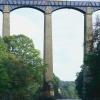
The Pontcysyllte Aqueduct carries the Llangollen (Ellesmere) Canal 1007ft (307m) across the River Dee to the south of Trefor Basin. It is one of the tallest cast iron aqueducts in the world, rising 127ft (39m) above the river bed and was built by William Jessop and Thomas Telford between 1795 and 1805, at a cost of £47,018.
The aqueduct comprises of 18 stone piers, on which is carried a cast iron trough. The location of the quarry and construction yard on the north (Trefor) side of the river determined the sequence for the construction of the structure. The stone piers were raised in stages starting with the lower sections of the river piers and then moving south to north across the valley, between six and eight metres in height at a time. Five timber gangways were constructed to transport materials, possibly via rail, and to provide platforms from which to work. Each gangway was supported on two timber beams supported by the stonework of the piers and by diagonal braces held in cast iron shoes secured to the stonework. Evidence of these features survive in the stonework of each pier and help verify a series of contemporary paintings which show the aqueduct under construction. The stone piers themselves are tapered and are also hollow in their upper sections, to reduce their overall weight.
The upper, trough, section of the aqueduct is entirely of cast iron, produced at a specially commissioned forge at nearby Plas Kynaston. The trough was constructed in 19 sections and is formed from 2 inch thick plates bolted together along flanges, the joints made watertight with a mixture of flannel, white lead and iron borings. Each section was supported by four arch ribs, cast in three sections and bolted together with connecting plates. The ribs sat on springing plates near the top of each stone pier. In order to maintain flexibility, the trough merely sits on top of these ribs, stopped from lateral movement by a series of brackets and lugs and weighted down by the volume of water it contains. The original wooden towpath was replaced in 1831 with the current cantilevered design. Both were designed to enable a wider circulation of water underneath the towpath, preventing the overflow of water. Although the use of cast iron was revolutionary, enabling the spectacular achievement of constructing the tallest and longest navigable aqueduct of its time, the form of the upper section harked back to earlier traditions with the outer ribs designed to give the sense of solidity and the raked side plates imitating the voussoirs of a stone arch.

More items with these tags
Mae'r eitem hon hefyd yn ymddangos yn


Cysylltwch â Ni
I wneud cais i dynnu i lawr neu riportio cynnwys hiliol, sarhaus neu niweidiol mewn unrhyw ffordd arall.

You must be logged in to leave a comment